. Alas, not me: Sauron
Showing posts with label Sauron. Show all posts

03 December 2025

"...the language ... of Mordor, which I will not utter here."

 ‘I cannot read the fiery letters,’ said Frodo in a quavering voice. 

‘No,’ said Gandalf, ‘but I can. The letters are Elvish, of an ancient mode, but the language is that of Mordor, which I will not utter here. But this in the Common Tongue is what is said, close enough: 

One Ring to rule them all, One Ring to find them, 
One Ring to bring them all and in the darkness bind them.
(FR 1.ii.50)

From time to time someone will ask why Gandalf will not utter the Black Speech in Bag End, but will do so in Rivendell. I saw this just the other day. It's a reasonable question. Here's the passage from The Council of Elrond for comparison. 

Upon this very ring which you have here seen held aloft, round and unadorned, the letters that Isildur reported may still be read, if one has the strength of will to set the golden thing in the fire a while. That I have done, and this I have read: 

            Ash nazg durbatulûk, ash nazg gimbatul, ash nazg thrakatulûk
                                        agh burzum-ishi krimpatul
.

The change in the wizard’s voice was astounding. Suddenly it became menacing, powerful, harsh as stone. A shadow seemed to pass over the high sun, and the porch for a moment grew dark. All trembled, and the Elves stopped their ears.

‘Never before has any voice dared to utter words of that tongue in Imladris, Gandalf the Grey,’ said Elrond, as the shadow passed and the company breathed once more.

(FR 2.ii.254)

Gandalf recites the enchantment in the Common Speech in Bag End. Nothing happens. Gandalf recites the enchantment in the Black Speech in Rivendell, the power of the Ring is invoked. The Elves don't just cover their ears because Gandalf has said some ugly words. His indiscretion is not social. He is not Gandalf the Gauche. He is Gandalf the Grey, a being of great power, calling upon the Ring of Sauron in a language it understands, as it were. A moment later he again recites the spell in the Common Speech. Again, nothing happens.

So, when Gandalf said to Frodo that he would "not utter [the language of Mordor] here," the word here does not mean here in the Shire. It means here in the presence of the Ring. He won't do it because he has an idea of what is going to happen. True, he doesn't want to frighten Frodo any more than he is already frightened. True, he doesn't want to risk drawing the attention of the Eye. The Shire is not safe enough. Rivendell is much safer than Hobbiton. Why does he do it at all? He is making a point and removing all doubt that this is in fact the One Ring.

21 January 2023

"Pity, Power, and Tolkien's Ring" finalist for The Tolkien Society Best Book Award 2024


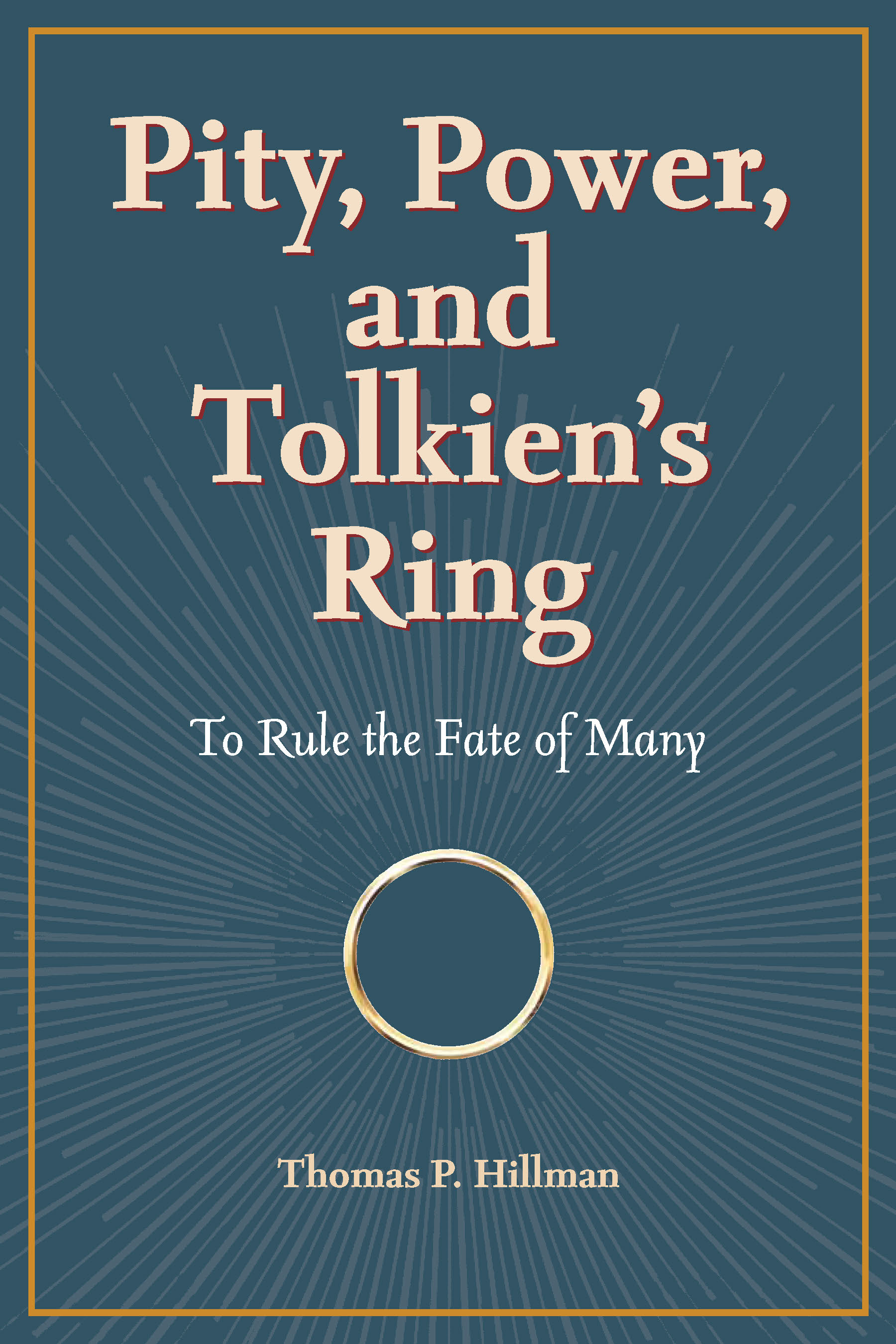
Pity, Power, and Tolkien's Ring:

 To Rule the Fate of Many


by 


Thomas P. Hillman

A brief description
As the magical ring Bilbo found in The Hobbit became the One Ring to rule them all in The Lord of the Rings, the tale he told of how he had won it became a lie, and the pity that spared Gollum’s life emerged from the darkness beneath the Misty Mountains to challenge the might of Sauron. Yet the pity that Gandalf holds essential to destroying the Ring and defeating Sauron offers the bearer no protection against the corruptions of its power. By joining Tolkien and Frodo on their long and weary road, Pity, Power, and the Ring: To Rule the Fate of Many illuminates the inner struggle Frodo had to face, and Tolkien had to create and explore, between the power Frodo weighs in his hand and the pity for the darkness he comes to hold in his heart.

In composing The Lord of the Rings, Tolkien spent over a decade exploring the dynamics of the power of the Ring and powerlessness of pity. As he did so, all the themes his mythology had embodied since its earliest days during The Great War – Death and Immortality, Fate and Free Will, Divine Justice and the Problem of Evil, Power and War – took on a new aspect at once more vulnerable and more heroic in Frodo Baggins. In turn, as Tolkien began to ponder the expression of these constant themes in The Lord of the Rings, his meditations led him onward to a more philosophical and theological treatment of the unfolding of Ilúvatar's themes in history in later works like the Atrabeth Finrod a Andreth and Laws and Customs Among the Eldar. Like the Beowulf-poet he understood so well, Tolkien could encompass in his sympathy Christian religion and Pagan mythology, the Primary World in which he lived the questions of life and the Secondary World in which he imagined the working out of their answers.


Kent State University Press has in recent years extended a warm welcome to the study of The Inklings, publishing twenty-seven titles so far, including fourteen on J. R. R. Tolkien. It is, therefore, with great pleasure that I announce the forthcoming publication of my book, Pity, Power, and Tolkien's Ring: To Rule the Fate of Many, which studies the evolving dynamics of the Ring of Power and the paradoxical yet all-important quality of pity, and how this quality came to resonate throughout the entire legendarium as a result of the decade and more Tolkien spent unfolding the history of Arda through the writing of The Lord of the Rings

I am abashed, to say the least, to find my book keeping the company of works by scholars such as Verlyn Flieger, Diana Pavlac Glyer, and Amy Amendt-Radeuge -- to name only those who have won The Mythopoeic Society's award for scholaship in Inklings Studies for their work on Tolkien. These and the other scholars who have published on the Inklings with Kent State University Press have of course been nominated for or won awards from scholarly bodies too many to mention here. It is a very flattering thing for my book to be included among them, to borrow a phrase from Tolkien, as a member of 'a class not as a competitor' (Letters no. 156, p. 201)

The ISBN for my book is 9781606354711. It may be purchased from all the usual suspects. 


11 December 2021

A Long-expected Parenthesis -- Part 5

Previously we have noted that parenthetical commentary appears and disappears as the story grows lighter and darker by turns, and that this in general follows the relationship of Bilbo and then Frodo with the Ring. We have also just seen a very similar dynamic occur with Merry and Pippin in Book Three. Though neither of them ever possesses the Ring, it is nevertheless Saruman's lust to acquire it and Sauron's to regain it that motivates their kidnapping by the orcs, thus directly causing the darker and lighter turns the narrative takes in The Uruk-hai and Treebeard. Indeed Merry and Pippin perceive the role the Ring is playing in their captivity, and with desperate audacity play upon Grishnákh's mistaken belief that they have it, wagering their lives for a chance at escape. So here, too, the Ring is intimately connected to the dynamic at work and the parentheses. Since it transfers so smoothly from Bilbo and Frodo to Merry and Pippin, and, as we shall presently see, to Sam, it should also be evident just how closely concerned with the hobbit voice these asides are. 

After the cluster of parentheses in Treebeard a long gap of 155 pages follows (TT 3.iv.483-4.iii.638), empty except for the somewhat knowing comment on the sinister multiple meanings of Orthanc (TT 3.viii.555). An even longer gap of 177 pages before Treebeard (3.iv.465) extends back to The Ring Goes South (FR 2.iii.288), also interrupted only once (2.vi.344). This lack of parenthetical comments elsewhere in Book Three coincides with the general absence of the hobbits from this book despite the crucial role played by Merry and Pippin, a dynamic to be repeated in Book Five. Something similar holds true also in Book Two, where the narrative attends more to the Company as a whole than to the hobbits or Frodo specifically. So darker turns in the narrative connected to the Ring may be the most striking reason for the absence of parentheses, but not the only reason.

In Book 4 parentheses reappear in The Black Gate Is Closed. As I noted in Part 4, in this book Sam begins to carry the burden of the narrative as Frodo becomes increasingly preoccupied by his struggle against the Ring. It is Sam to whom the three parenthesis in The Black Gate Is Closed refer, at least two of which give us Sam's commentary on his own thoughts at the time (TT 4.iii.638, 640), and the third almost certainly does, too (4.iii.647). This last is perhaps the most remarkable since Sam's behavior in the tale here is as lighthearted as his comment on it, recalling Frodo from the darkness of his cares and purpose by this recitation of 'the old fireside rhyme of Oliphaunt' outside the Black Gate of Mordor, and recalling for the reader an earlier such moment where Sam did the same thing in the same way, hands behind his back and all (FR 1.xii.206-208). Consider also the comment in Of Herbs and Stewed Rabbit where we learn that Sam is 'a good cook, even by hobbit reckoning' (TT 4.v.653), an art hobbits 'begin to learn before their letters (which many never reach)'. Here we must remember that Sam was called out by name a full chapter and seventeen years before we met him as a hobbit who had learned his letters. As with his pose while 'speaking poetry', the narrator is using the parentheses to remind the reader of how special Sam is. Not only could he cook the cabbages and potatoes which his Gaffer thought he'd be better off minding, but he knew his letters and poetry and great tales, which repeatedly helped to sustain him on the long road into darkness he and Frodo had to walk. His sense of mission comes from his learning his letters. Sam Gamgee had read all the right books.

These parentheses also further mark the shift we saw earlier with Merry and Pippin, a shift away from Frodo as his hobbit comrades step forward and begin to take up the roles they will play until the end of the book. This is not to say that Frodo is becoming less important. Far from it. But his are now not the only small hands that turn the wheels of the world while the eyes of the great are elsewhere. Sam in particular becomes critically important, and increasingly the story of Frodo's journey is seen through his eyes because Frodo's eyes are elsewhere.


19 May 2021

'It did not always seem of the same size or weight' (FR 1.ii.47)

'Though [Bilbo] had found out that the [Ring] needed looking after; it did not seem always of the same size or weight; it shrank or expanded in an odd way, and might suddenly slip off a finger where it had been tight.'

(FR 1.ii.47) 

To argue that the Ring does not in truth change weight is fairly easy. For, although both Frodo and Sam feel it to be a physically heavy burden while they are bearing it, Sam is surprised to find when he carries Frodo up Mt Doom that he feels only the weight of Frodo (RK 6.iii.940). The changes in size, however, are probably not illusory. 

Recall that Sauron changes shape and appearance more than once in The Silmarillion, from human to werewolf to vampire bat (175). Recall also that in the Second Age, during which he forges the One Ring and transfers much of his native power into it, he can still change his form and appearance (285). After he is killed in the Drowning of Númenor, however, he can no longer 'put on his fair hue' (285) or 'appear fair to the eyes of Men' (280); and after he is killed again and the Ring taken from him he cannot take shape again for centuries (UT 388-89). Now since he had been able to change his size and shape previously it makes sense that the Ring would need to possess the same capacity if only for practical purposes. After his deaths the power he put into the Ring remains in the Ring, and so it adjusts to the hand that wears it. 


14 December 2020

A thought on the 'sentience' of the Ring

To say definitively if the One Ring is or is not sentient may not in the end be possible. To do so would surely require an attentive and thorough examination of the question. I tend to believe that it is not, but I also think that the ambiguity is both intentional and important. I am not pursuing that overall question here today, only a portion of it that has only recently become clear to me.

It struck me that Of Aulë and Yavanna supplies important testimony against the sentience of the Ring. Here's the passage in question (emphases mine):

Now Ilúvatar knew what was done, and in the very hour that Aulë's work was complete, and he was pleased, and began to instruct the Dwarves in the speech that he had devised for them, Ilúvatar spoke to him; and Aulë heard his voice and was silent. And the voice of Ilúvatar said to him: 'Why hast thou done this? Why dost thou attempt a thing which thou knowest is beyond thy power and thy authority? For thou hast from me as a gift thy own being only, and no more; and therefore the creatures of thy hand and mind can live only by that being, moving when thou thinkest to move them, and if thy thought be elsewhere, standing idle. Is that thy desire?'

Then Aulë answered: 'I did not desire such lordship. I desired things other than I am, to love and to teach them, so that they too might perceive the beauty of Eä, which thou hast caused to be. For it seemed to me that there is great room in Arda for many things that might rejoice in it, yet it is for the most part empty still, and dumb. And in my impatience I have fallen into folly. Yet the making of things is in my heart from my own making by thee; and the child of little understanding that makes a play of the deeds of his father may do so without thought of mockery, but because he is the son of his father. But what shall I do now, so that thou be not angry with me for ever? As a child to his father, I offer to thee these things, the work of the hands which thou hast made. Do with them what thou wilt. But should I not rather destroy the work of my presumption?'

Then Aulë took up a great hammer to smite the Dwarves; and he wept. But Ilúvatar had compassion upon Aulë and his desire, because of his humility; and the Dwarves shrank from the hammer and were afraid, and they bowed down their heads and begged for mercy. And the voice of Ilúvatar said to Aulë: 'Thy offer I accepted even as it was made. Dost thou not see that these things have now a life of their own, and speak with their own voices? Else they would not have flinched from thy blow, nor from any command of thy will.' Then Aulë cast down his hammer and was glad, and he gave thanks to Ilúvatar, saying: 'May Eru bless my work and amend it!'

(S 43-44) 

Without the direct intervention of Ilúvatar, all of Aulë's power and craft and love cannot give sentience or consciousness to the Dwarves. Now Of Aulë and Yayanna dates from 1958, so we must naturally take care when using it to support a point about The Lord of the Rings. Yet the notion of making something in mockery recalls the remarks of Treebeard at TT 3.iv.486 and of Frodo at TT 6.i.914: 'The Shadow that bred them can only mock, it cannot make: not real new things of its own. I don't think it gave life to the orcs, it only ruined them and twisted them....' So, it seems clear enough that, when writing The Lord of the Rings, Tolkien already had in mind some version of the principle we see several years later in Of Aulë and Yayanna. 

The story that Aulë made the Dwarves arose first in the 1930s, but Ilúvatar plays no role in it and the Dwarves have 'no spirit indwelling, as have the Children of Ilúvatar' (Lost Road, 129), though here this does not deprive them of sentience. This strongly suggests that Tolkien's thought was already moving along the lines we see later, even if he had not yet decided that only Ilúvatar could create autonomous beings which have 'a life of their own, and speak with their own voices'. In letter 153, moreover, written only weeks after the publication of The Fellowship of the Ring in 1954Tolkien points out that while Melkor could have made the flesh and blood of the orcs by the power that was in him, he could not have given them souls or spirits, because that is not a power Ilúvatar 'delegated'. In the same letter he also remarks: 'when you make Trolls speak you are giving them a power, which in our world (probably) connotes the possession of a 'soul'. (Compare also the implicit link between consciousness and speech in Treebeard's remark that the old Elves woke the trees up and taught them to speak [TT 3.iv.468]). What Melkor could not do, Aulë and Sauron could not have done either. 

Note, too, that Gandalf says Sauron 'let a great part of his former power pass into [the Ring], so that he could rule all the others' (FR 1.ii.51), and that, if the Ring is destroyed, Sauron 'will lose the best part of the strength that was native to him in the beginning', which would reduce him to 'a mere spirit of malice that gnaws itself in the shadows, but cannot grow again or take shape' (RK 5.ix.878). Here we see a clear distinction drawn between Sauron's spirit and his power or strength. The Ring contained his power, but not his spirit. Nor could he give it one. So whatever sentience or consciousness the Ring may possess, if it should possess any at all, seems little likely to have arisen from Sauron's having endowed it with his power (which he did) or with his spirit (which he did not do). It was, however, 'fraught with his malice' according to Elrond (FR 2.ii.254), that is, 'furnished with' or 'filled with', 'carrying with it as an attribute', 'destined to produce' (OED). Which is not to say that it feels malice.

What we have seen here argues against the sentience of the Ring. There are other passages that bear on this question in different ways, and other objects that may or may not be sentient, but they are not my concern here. I shall return to them in time. 

30 November 2020

'Der mentsh* trakht un got lakht': Divine Irony and the Ring Verse.

 Just this morning I was reflecting on the incantatory lines at the heart of the Ring verse:

One Ring to rule them all, one ring to find them
One Ring to bring them all, and in the darkness bind them

The emphatically repeated 'them' refers as much to the bearers of the other Rings of Power as it does to the Rings themselves. The intent to enslave the bearers was imperfectly realized of course, except in the case of Men. It occurs to me, however, that these verses also reflect the relations of the three agents of the eucatastrophe at Mt Doom, Frodo, Gollum, and Sam, all of whom of course are Ringbearers. The Ring brought them all together and bound them in the literal darkness of Mordor. Frodo 'wouldn't have got far without Sam' (TT 4.viii.712) and 'but for [Gollum]' Frodo 'could not have destroyed the Ring' (RK 6.iii.947). Frodo, however, 'was meant to have the Ring' as much as Bilbo had been (FR 1.ii.55), but it was not the maker of the Ring who intended this.

'[T]here was something else at work', as Gandalf tells Frodo. That 'something' read the Ring verse ironically, in a sense no one else grasped, much like the words that in truth prophesied the Witch-king's death rather than his invulnerability. Just as Éowyn, Merry, and the barrow-blade were brought together as if by chance to belie the obvious meaning of 'not by the hand of man shall he fall' (RK 5.vi.840; App. A 1051), so too, the coming together of Frodo, Gollum, and Sam at Mt Doom reveals new meaning in the Ring verse. 

It is a new meaning such as Eru prophesied to Melkor before the world was made (Silm. 17) :

'.... And thou, Melkor, shalt see that no theme may be played that hath not its uttermost source in me, nor can any alter the music in my despite. For he that attempteth this shall prove but mine instrument in the devising of things more wonderful, which he himself hath not imagined.'

____________________

*The use of this word here should not be taken to imply that Sauron was ever a mentsh to anyone, anywhere, at any time. 

01 May 2020

Authorial high-jinks on the slopes of Mount Doom


As we've seen before, Tolkien is hardly averse to slipping a bit of humor or even (gasp!) irony into his writing. We might not expect it on the slopes of Mount Doom, however.
And far away, as Frodo put on the Ring and claimed it for his own, even in Sammath Naur the very heart of his realm, the Power in Barad-dur was shaken, and the Tower trembled from its foundations to its proud and bitter crown. The Dark Lord was suddenly aware of him, and his Eye piercing all shadows looked across the plain to the door that he had made; and the magnitude of his own folly was revealed to him in a blinding flash, and all the devices of his enemies were at last laid bare. Then his wrath blazed in consuming flame, but his fear rose like a vast black smoke to choke him. For he knew his deadly peril and the thread upon which his doom now hung. 
(RK 6.iii.946, emphasis mine)

Sauron's discovery of what a fool he's been is apocalyptic both literally and metaphorically, and I would be hard-pressed to say which sense predominates. The Greek verb from which apocalypse and apocalyptic derive -- ἀποκαλύπτω -- means quite simply 'to reveal', as in 'the magnitude of his folly was revealed to him'. The New Testament book known in English as Revelation is called Ἀποκάλυψις (Apocalypsis) in the Greek original. Metaphorically, of course, it has been used for well over a century to mean: 

'Of, relating to, or characteristic of a disaster resulting in drastic, irreversible damage to human society or the environment, esp. on a global scale; cataclysmic.' 
(OED)
 That same sentence also recalls the moment thousands of years before, which Gandalf spoke of in The Council of Elrond:

For in the day that Sauron first put on the One, Celebrimbor, maker of the Three, was aware of him, and from afar he heard him speak these words, and so his evil purposes were revealed. 
(FR 2.ii.253)
and
Out of the Black Years come the words that the Smiths of Eregion heard, and knew that they had been betrayed: 
   One Ring to rule them all, One Ring to find them,
   One Ring to bring them all and in the Darkness bind them.
(FR 2.ii.254)

The irony here is nothing short of precious.

Finally there's the 'blinding flash' which paradoxically allows Sauron to see, which it is tempting to see as an allusion to Amazing Grace, except that in Tolkien's time Roman Catholics and Protestants were rather less ecumenical with their hymns than they have since become. Then, too, Amazing Grace seems to have been far better known in the US than it was in the UK, where it only became popular in the 1950s and was first published in a hymnody in the 1960s. So, we had better regard this as unlikely to be an allusion, though not impossible.

16 February 2018

And thus was Númenor avenged (RK 6.iii.947)

"Queen Tar-Miriel and the Great Wave" © Ted Nasmith


That Tolkien had a recurring dream of a great green wave rushing across the land, which informed his description of the drowning of Númenor, is well known (Letters nos. 131, 163, 180, 257, 276). Indeed the paragraph describing the last moments of Númenor is remarkable for its beauty and its sorrow.
In an hour unlooked for by Men this doom befell, on the nine and thirtieth day since the passing of the fleets. Then suddenly fire burst from the Meneltarma, and there came a mighty wind and a tumult of the earth, and the sky reeled, and the hills slid, and Númenor went down into the sea, with all its children and its wives and its maidens and its ladies proud; and all its gardens and its balls and its towers, its tombs and its riches, and its jewels and its webs and its things painted and carven, and its lore: they vanished for ever. And last of all the mounting wave, green and cold and plumed with foam, climbing over the land, took to its bosom Tar-Míriel the Queen, fairer than silver or ivory or pearls. Too late she strove to ascend the steep ways of the Meneltarma to the holy place; for the waters overtook her, and her cry was lost in the roaring of the wind.
(Silm. 279)

Tonight I once again reached the fall of Barad-dûr in The Return of the King and noticed, as if for the first time, a link between the two passages. Given the importance of the image of the wave to Tolkien, it seems hard to see it otherwise:

A brief vision he had of swirling cloud, and in the midst of it towers and battlements, tall as hills, founded upon a mighty mountain-throne above immeasurable pits; great courts and dungeons, eyeless prisons sheer as cliffs, and gaping gates of steel and adamant: and then all passed. Towers fell and mountains slid; walls crumbled and melted, crashing down; vast spires of smoke and spouting steams went billowing up, up, until they toppled like an overwhelming wave, and its wild crest curled and came foaming down upon the land. 
(RK 6.iii.947, italics mine)

Elsewhere I have noted that the Mouth of Sauron has (just) sneered at Aragorn by reminding him of Númenor 'the downfallen'.  It seems particularly apt then that we find the downfall of Sauron, who did so much to entice the Númenóreans to their destruction, quietly mocked in such similar terms. 


_____________________________________


_____________________________________

10 February 2017

Some Thoughts on Structure and Meaning in The Lord of the Rings

Yes, Simon. There she is again


Quite a few years ago now in his still highly relevant article, 'The Interlace Structure of The Lord of the Rings', Richard West made clear how intricately woven together The Lord of the Rings is. Unlike the simpler and more 'organic' practice common in modern novels, the medieval technique of '[i]nterlace, by contrast, seeks to mirror the perception of the flux of events in the world around us' (West 78), which leads to a narrative that, like life, is 'cluttered', 'digressive', and 'chaotic' (79). But there's more to it than that, as West points out:
Yet the apparently casual form of the interlace is deceptive; it actually has a very subtle kind of cohesion. No part of the narrative can be removed without damage to the whole, for within any given section there are echoes of previous parts and anticipations of later ones. The medieval memory (lacking modern information retrieval systems and therefore necessarily greater than ours) delighted in following repetitions and variations of themes, whether their different appearances were separated by scores or hundreds of pages. Musical art gives an analogous aesthetic pleasure and shows a similar structural binding ... but in literature, the interlace structure allows detailed examination of any number of facets of a theme.
(West 79)
Now in the course of The Lord of the Rings Frodo offers to give the Ring to others three times, but all of these come in the first two books, and never again after that.  A proximate cause is easy to spot -- Boromir's attempt to take the Ring at the end of the second book -- but that is only part of it. It is not the truest cause.  For in the first two books Tolkien weaves together a series of offers by Frodo with a series of (real and imagined) attempts by others to take the Ring. How these offers and attempts are made are telling in themselves, but as with Boromir each of them is part of the larger web of the story and allows us to reflect on questions of the effect the Ring has on those who possess it, claim it, or who have considered what they might accomplish if it were theirs.

  1. In The Shadow of the Past Frodo offers the Ring to Gandalf in fear, but has just proved himself unable even to throw the Ring into his fireplace, which, it has already been demonstrated, is scarcely able to warm it up (FR 1.ii.49-50, 60-61). Gandalf refuses the Ring, also out of fear, because he knows his 'pity for weakness and the desire of strength to do good' will make him a prey to the Ring's power. Given the truculence with which Bilbo, like Gollum before him, asserted and defended his claim to ownership of the Ring in A Long-expected Party, Frodo's offer to Gandalf is tantamount to a denial of a claim to the Ring. 

  2. In The Council of Elrond Frodo, upon learning that Aragorn is Isildur's heir, seems almost relieved: '"Then [the Ring] belongs to you, and not to me at all!" cried Frodo in amazement, springing to his feet, as if he expected the Ring to be demanded at once.' Aragorn replies, 'It does not belong to either of us...but it has been ordained that you should hold it for a while' (FR 2.ii.237).  Frodo here in fact asserts Aragorn's claim to the Ring. This not only shows how true and wise Aragorn is by his refusal, but also supports the view taken above that Frodo has so far refused to claim the Ring. 

  3. In The Mirror of Galadriel Frodo's perception of things that are hidden and secret is enlarged, because he is 'the Ring-bearer, and one who has seen the Eye' in Galadriel's Mirror. This puts him on more of an even footing with Galadriel, since it allows him to recognize her as another Ring-bearer. Now he asks her what she wants, just as she had asked all the members of the Fellowship earlier in this chapter, and the fears for Lothlórien she reveals in her response parallel Frodo's fears for the Shire in The Shadow of the Past (FR 1.ii.62), as well as those stirred in Sam by what he has just seen in the Mirror.  In all humility then, it seems, Frodo offers to give her the Ring, and by implication renounces any claim to it: 'I will give you the One Ring, if you ask for it. It is too great a matter for me.'  Like Gandalf and Aragorn, Galadriel also refuses, but not without admitting the dreams of power and glory she had dreamt, as she pondered what she would do if the Ring ever came into her possession; and not before giving Frodo a glimpse of the majesty she would attain with the One Ring on her hand (FR 2.vii.365-66). It is intriguing, however, that here the offer of the Ring is conditional -- 'if you ask for it.' Requiring her to ask for it is an assertion of power and control, and suggests that Frodo's attitude towards the Ring has been changing. It is also intriguing that no sooner does she reject the Ring than he asks her how he might use it to 'see all the [other Rings] and know the thoughts of others', which Galadriel warns him not to try, since to use the power of the Ring would require him to train his 'will to the domination of others.' To try, she says, 'would destroy you.'
In addition to these three offers to give up the Ring -- whether Frodo could have actually done so if anyone had accepted is another matter -- Books One and Two begin and end with attempts, two real and two imagined, to seize the Ring -- 
  1. In A Long-expected Party Bilbo claims that the Ring is his when Gandalf urges him to give it to Frodo: 'It is my own. I found it. It came to me.' But, as Gandalf continues to press him, Bilbo grows paranoid and fears that Gandalf wants the Ring for himself and will try to take it by force.  He lays his hand on his sword, implicitly threatening the kind of violence he had so significantly eschewed by not stabbing Gollum when he had the chance (FR 1.i.34).  

  2. In The Flight to the Ford the Black Riders very nearly catch Frodo at the Ford of Bruinen (FR 1.xii.213-15). He attempts to command them, but they laugh at him. His questioning Galadriel about using the Ring needs to be read in connection with his failure here. His later invocations of the Ring to control Gollum (TT 4.i.618, iii.640; RK 6.iii.943-44), his wondering whether he was ready to confront the Witch-king at Minas Morgul ('not yet' -- TT 4.viii.706), and his claiming the Ring for his own (RK 6.iii.945), are all obvious 'facets' of this 'theme', but so, too, is his subsequent mourning for its loss (RK 6.ix.1024)

  3. In Many Meetings Bilbo's reaching out to touch the Ring sparks a reaction in Frodo as paranoid and close to violence as Bilbo's response to Gandalf had been (FR 2.i.232). This moment is significant in three ways: first, in showing the effect the Ring is already having on Frodo by recalling Bilbo's behavior in A Long-expected Party; second, by enabling Bilbo to understand at last what the Ring does to those who bear it; and third, by the alarmingly small effect this moment has on Frodo's understanding of what the Ring is doing to him: he just moves on. 

  4. In The Breaking of the Fellowship Boromir almost succeeds in seizing the Ring for himself (FR 2.x.396-400).  Frodo escapes only because he uses the Ring, which also results in vastly expanding his perception of the world, but in doing so he nearly reveals himself to Sauron, just as he had almost done, it would seem, when looking into Galadriel's mirror 11 days earlier. 

As Boromir's attempt follows so closely upon Frodo' offer to Galadriel, it might be worthwhile to consider these two moments side by side. Galadriel confesses that she has wanted the Ring, but will not take it or ask for it. She knows well that any good she might do at first will only end in despair. Boromir does not have the wisdom to see this -- he imagines himself becoming 'a mighty king, benevolent and wise.'  He not only wants the Ring, but requests it and will brook no refusal.  Frodo's psychic brushes with Sauron in these episodes, which emphasize his own increasingly complex relationship with the Ring -- 'He heard himself crying out: Never, never! Or was it: Verily I come, I come to you?' (FR 2.x.401) -- must be viewed in context with Galadriel's silent probing of Boromir's mind at their first meeting in Lothlórien, an encounter   that left Boromir rattled and suspicious, and Galadriel concerned that he was in peril (TT 3.v.496). Who would grasp that peril better than she? Who would find her desire to save her land and people more unnerving than Boromir? As Faramir later wonders, from a fascinating perspective that encompasses both sides of the experience: 'What did she say to you, the Lady that dies not? What did she see? What woke in your heart then?' (TT 4.v.667).  Boromir and Galadriel will have seen in each other's thoughts a reflection of their own fears and desires.

There are of course other scenes in the first two books that we might examine in greater depth, to see how they might contribute to our understanding of the Ring and the relationship of Frodo and others to it. In addition to some of the passages cited within the points made above, the scenes in the Shire, at Bree, and on Weathertop would be worth closer inspection. From my discussion of these same passages we can also see that much more lies ahead, which I have not yet fully thought through, and which will doubtless alter my own understanding of what I have seen so far. Still it would be foolish to think that every last passage can or should be fitted into some sort of pattern, as tempting as that can often be. 

But there is one more rather eccentric piece of this puzzle that I think requires comment at this time. In The Old Forest Tom Bombadil comes plunging into the story like some rogue comet from the Oort Cloud. The hobbits spend most of three chapters in Tom's Country, measuring from the High Hay to the East Road beyond the Barrow-downs, just as they do later in Lothlórien. Unlike Galadriel, however, Bombadil asks to see the Ring, which Frodo, to his own surprise, gives him without demur, but when Bombadil puts on the Ring and makes it disappear instead of vanishing himself, Frodo becomes alarmed and suspicious. Even though Bombadil immediately returns the Ring, Frodo must test it to be sure he hasn't been tricked. Again, the Ring has no effect on old Tom, who sees Frodo quite clearly (FR 1.vii.132-33).  Pardoxically Frodo reveals himself by disappearing. The Ring is already at work on him. Unlike Galadriel and everyone else in The Lord of the Rings, however, Tom is his own Master and desires nothing but what he has. Thus the power of the Ring has no pull on him. He knows of the Ring, but seems to have little interest in it except as a curiosity (cf. FR 2.ii.265).

Like Lothlórien, Tom's Country is also Faërie. Under his mastery time there flows differently from time in Bree or The Shire or Rohan, but not in the same way as it does in Lórien, from which one emerges to find that one has fallen behind time in the mortal world. In Tom's Country it is always the present, but the past remains vibrant and accessible: Tom can still go singing out into the ancient starlight when only the Elf-sires were awake (FR 1.vi.131); the trees can remember 'the times when they were lords' (FR 1.vii.130); the Barrow-wights can recall the first Dark Lord (FR 1.viii.141); and visions of Dunedain kings, once and future, can rise up before the hobbits' eyes as well as in their dreams (FR 1.viii.143, 145-46).  In Galadriel's Golden Wood we may also see visions of times past and times perhaps to come, but the land itself is anchored in an age long gone: In Lórien the Elder Days 'still lived on in the waking world' (FR 2.vi.349), but only if she had the One Ring could she perhaps preserve it that way forever. Tom and his Country serve as another structural counterpoise to Galadriel and hers.

What, finally, is the theme whose facets we are examining through this extensive and intricate web? Perhaps that which Gandalf touched upon first in The Shadow of the Past and which Elrond expands upon in The Council of Elrond, two chapters which occupy the same position and play much the same part in their respective books:
‘A mortal, Frodo, who keeps one of the Great Rings, does not die, but he does not grow or obtain more life, he merely continues, until at last every minute is a weariness. And if he often uses the Ring to make himself invisible, he fades: he becomes in the end invisible permanently, and walks in the twilight under the eye of the dark power that rules the Rings. Yes, sooner or later – later, if he is strong or well-meaning to begin with, but neither strength nor good purpose will last – sooner or later the Dark Power will devour him.’
(FR 1.ii.47)
And:
'Alas, no,' said Elrond. 'We cannot use the Ruling Ring. That we now know too well. It belongs to Sauron and was made by him alone, and is altogether evil. Its strength, Boromir, is too great for anyone to wield at will, save only those who have already a great power of their own. But for them it holds an even deadlier peril. The very desire of it corrupts the heart. Consider Saruman. If any of the Wise should with this Ring overthrow the Lord of Mordor, using his own arts, he would then set himself on Sauron's throne, and yet another Dark Lord would appear. And that is another reason why the Ring should be destroyed: as long as it is in the world it will be a danger even to the Wise. For nothing is evil in the beginning. Even Sauron was not so. I fear to take the Ring to hide it. I will not take the Ring to wield it.' 
'Nor I,' said Gandalf. 
Boromir looked at them doubtfully, but he bowed his head. 'So be it,' he said.  
(FR 2.ii.267)
This is how good becomes evil. Boromir's question to Frodo on Amon Hen -- if the Wise won't wield the Ring, someone has to: 'Why not Boromir?' (FR 2.x.398) -- is not all that different from Frodo's asking Galadriel about using the Ring himself the moment she has refused his offer.

It will be interesting to see how this line of inquiry unfolds from here.


Richard C. West, 'The Interlace Structure of The Lord of the Rings' in Jared Lobdell, A Tolkien Compass (1975), pp. 77-94.


______________________________


______________________________


11 February 2016

"We will burn like heathen kings before ever a ship sailed hither from the West." (RK 5.iv.825)


In my recent Abraham, Wilfred, and John at The Pyre of Denethor (RK 6.vii.850-57) we saw how Tolkien and Owen each used Genesis 22 to inform his own art.  One striking aspect of Tolkien's text that received only scant attention was the two uses of 'heathen.' This word occurs nowhere else in The Lord of the Rings or The Hobbit, The Silmarillion, The Book of Lost Tales, Unfinished Tales, or in the fiction and poetry contained in The History of Middle-Earth, with one exception which we will consider presently. 

Now 'heathen', according to the Oxford English Dictionary, 'is applied to persons or races whose religion is neither Christian, Jewish, nor Mohammedan; pagan; Gentile. In earlier times applied also to Mohammedans, but in modern usage, for the most part, restricted to those holding polytheistic beliefs, esp. when uncivilized or uncultured.'1 So within The Lord of the Rings it clearly requires explanation.

Here are the two passages in which the word occurs:
Messengers came again to the chamber in the White Tower, and Pippin let them enter, for they were urgent. Denethor turned his head slowly from Faramir's face, and looked at them silently. 
'The first circle of the City is burning, lord,' they said. 'What are your commands? You are still the Lord and Steward. Not all will follow Mithrandir. Men are flying from the walls and leaving them unmanned.' 
'Why? Why do the fools fly?' said Denethor. 'Better to burn sooner than late, for burn we must. Go back to your bonfire! And I? I will go now to my pyre. To my pyre! No tomb for Denethor and Faramir. No tomb! No long slow sleep of death embalmed. We will burn like heathen kings before ever a ship sailed hither from the West. The West has failed. Go back and burn!'  
The messengers without bow or answer turned and fled. 
(RK 5.iv.825)
And:
'Authority is not given to you, Steward of Gondor, to order the hour of your death,' answered Gandalf. 'And only the heathen kings, under the domination of the Dark Power, did thus, slaying themselves in pride and despair, murdering their kin to ease their own death.'
(RK 5.vii.853)
Tolkien here uses 'heathen' to distinguish between the men of Middle-earth before and after year 600 of the Second age when the Dúnedain first returned from Númenor. And in the only other passage where we find the word -- not surprisingly, in The Notion Club Papers -- the link between heathendom and Sauron (here called Zigur) is reinforced:
Then he, King (Tarcalion) landed on the shores of middle-earth, and at once he sent his messengers to (Zigur), commanding him to come in haste to do homage to the king; and he (Zigur) dissembling humbled himself and came, but was filled with secret malice, purposing treachery against the people of the Westfarers..... Thus he led astray wellnigh all the (Numenore)ans with signs and wonders.... and they built a great temple in the midst of the town (of Arminaleth) on the high hill which before was undefiled but now became a heathen fane, and they there sacrificed unspeakable offerings on an unholy altar.... Thus came death-shade into the land of the Westfarers and God's children fell under the shadow.
(HoME IX.258, emphasis added)
So, by falling under the domination of Sauron, the Númenoreans, till then 'God's children', became heathens. And, to see the meaning even more clearly, we need only recognize that the words 'a heathen fane' are the character Rashbold's translation from an Old English original of the words 'haethenum herge' (HoMe IX.257), literally a 'temple for the heathens.'2 The point here is not to criticize Tolkien's translation, but to emphasize what the translation may not fully reveal to the modern ear, namely, that 'heathen' in 'a heathen fane' is a religious reference to a group of people who are not or are no longer God's children; it is not merely a disparaging synonym for 'barbaric' or 'uncivilized,' as it has become for most moderns. It is also perhaps noteworthy that the other four uses of heathen in The Notion Club Papers refer to pagan Vikings (IX 269, 270 twice, 272). That is, they refer to people, proper heathens, who are rightly so called.

Thus, for Denethor to liken himself and his son to 'heathen kings,' and for Gandalf to agree with this characterization, apparently without any knowledge of Denethor's statement, indicates that this word and the act which Denethor has in mind share a meaningful context, at least for those like Gandalf and Denethor whose knowledge of the history of Men in Middle-earth is deep. Equally obviously the word here has nothing to do with Christianity, but rather with the few slim references we find to 'worship' in Tolkien's legendarium.

The most immediate to spring to mind here would be the Men of the Mountains who betrayed Isildur during the War of the Last Alliance, 'for they had worshipped Sauron in the Dark Years' (RK 5.ii.782). Then, too, there is the Mouth of Sauron, of the race of the Black Númenoreans who, 'during the years of Sauron's domination' had 'worshipped' him (RK 5.x.888). With the next we leave The Lord of the Rings and turn to Akallabêth, which brings us once again into close contact with the passage from The Notion Club Papers which we saw above:
Then Ar-Pharazôn the King turned back to the worship of the Dark, and of Melkor the Lord thereof, at first in secret, but ere long openly and in the face of his people; and they for the most part followed him
(Silm. 272)
Turned back?

Now since the worship of any but Eru had been previously unknown in Númenor, and since the remarks of Denethor and Gandalf clearly are not referring to the Númenoreans as 'heathens', but rather as those who rescued the men of Middle-earth from both the domination of Sauron and heathen practices,3  these words -- 'turned back' -- can only refer to a much earlier period, one rarely mentioned and one few men apparently knew much about, though it loomed behind them like a cloud:

But when [Finrodquestioned him concerning the arising of Men and their journeys, Bëor would say little; and indeed he knew little, for the fathers of his people had told few tales of their past and a silence had fallen upon their memory. 'A darkness lies behind us,' Bëor said; 'and we have turned our backs upon it, and we do not desire to return thither even in thought. Westwards our hearts have been turned, and we believe that there we shall find Light.'  
But it was said afterwards among the Eldar that when Men awoke in Hildórien at the rising of the Sun the spies of Morgoth were watchful, and tidings were soon brought to him; and this seemed to him so great a matter that secretly under shadow he himself departed from Angband, and went forth into Middle-earth, leaving to Sauron the command of the War. Of his dealings with Men the Eldar indeed knew nothing, at that time, and learnt but little afterwards; but that a darkness lay upon the hearts of Men (as the shadow of the Kinslaying and the Doom of Mandos lay upon the Noldor) they perceived clearly even in the people of the Elf-friends whom they first knew. 
(Silm. 141)
That darkness upon the hearts of Men was the result of a Fall, in which hasty humans chose to follow Melkor, who promised them much and soon, rather than the Voice they heard, who counselled them that it was better for them to discover things slowly on their own. Too late they learned they had chosen wrong. For so says Adanel, wise woman of the Edain in the First Age, who told the tale to her kinswoman of Andreth:
The first Voice we never heard again, save once. In the stillness of the night It spoke, saying: 'Ye have abjured Me, but ye remain Mine. I gave you life. Now it shall be shortened, and each of you in a little while shall come to Me, to learn who is your Lord: the one ye worship, or I who made him.'      
(Morgoth 347)
This Tale of Adanel is 'given explicitly as a Númenórean tradition' (Morgoth 344), which brings it into close contact with Akallabêth, written by Elendil himself (UT 224), and allows us an understanding of 'turned back' not otherwise possible. Whether Ar-Pharazôn himself knew this tradition about the worship of Melkor himself and thus knowingly turned back is unclear, but Elendil did and saw the Fall happening all over again. Little wonder he called his account 'The Downfallen.'

 ________________


OED s.v. 'heathen'. 'Mohammedan,' while outdated and offensive today, was common usage at the time the OED was first published.

Rashbold is pun, being a literal translation of the name 'Tolkien' from its German roots.

3 We need to distinguish between the worship of Sauron and the worship of Melkor. Clearly different groups practiced each of them. As has been pointed out many times, Sauron could hardly have credibly proposed to Ar-Pharazôn, his seeming conqueror, that the king should worship him as a god as he was worshipped in Middle-earth. Thus he turned him back to Melkor, cynically or sincerely, but expediently all the same. On this, see Morgoth 398:
Sauron was not a 'sincere' atheist, but he preached atheism, because it weakened resistance to himself (and he had ceased to fear God's action in Arda).  As was seen in the case of Ar-Pharazôn. But there was seen the effect of Melkor upon Sauron: he spoke of Melkor in Melkor's own terms: as a god, or even as God. This may have been the residue of  a state which was in a sense a shadow of good: the ability once in Sauron at least to admire or admit the superiority of a being other than himself. Melkor, and still more Sauron himself afterwards, both profited by this darkened shadow of good and the services of 'worshippers'.  But it may be doubted whether even such a shadow of good was still sincerely operative in Sauron by that time. His cunning motive is probably best expressed thus. To wean one of the God-fearing from their allegiance it is best to propound another unseen object of allegiance and another hope of benefits; propound to him a Lord who will sanction what he desires and not forbid it. Sauron, apparently a defeated rival for world-power, now a mere hostage, can hardly propound himself; but as the former servant and disciple of Melkor, the worship of Melkor will raise him from hostage to high priest. But though Sauron's whole true motive was the destruction of the Númenóreans, this was a particular matter of revenge upon Ar-Pharazôn, for humiliation. Sauron (unlike Morgoth) would have been content for the Númenóreans to exist, as his own subjects, and indeed he used a great many  of  them  that he corrupted to his allegiance.    

I believe there is also a link here between King Sheave and the idea of the ships sailing in from the West and 'converting' the heathens to whom Gandalf and Denethor refer, but that is for another day. 

01 December 2015

Abraham, Wilfred, and John at the Pyre of Denethor (RK 5.vii.850-57)

The Parable of the Young Man and the Old
So Abram rose, and clave the wood, and went,
And took the fire with him, and a knife.
And as they sojourned both of them together,
Isaac the first-born spake and said, My Father,
Behold the preparations, fire and iron,
But where the lamb for this burnt-offering?
Then Abram bound the youth with belts and straps,
and builded parapets and trenches there,
And stretchèd forth the knife to slay his son.
When lo! an angel called him out of heaven,
Saying, Lay not thy hand upon the lad,
Neither do anything to him. Behold,
A ram, caught in a thicket by its horns;
Offer the Ram of Pride instead of him. 
But the old man would not so, but slew his son,
And half the seed of Europe, one by one.

In discussing Faramir during his recent course at Signum University, 'Tolkien's Wars and Middle-earth'John Garth astutely noted the parallels between Faramir's relationship with his father in The Pyre of Denethor (RK 5.vii).850-57 and Isaac's relationship with Abraham in Wilfred Owen's The Parable of the Young Man and the Old, which retells the story of Genesis 22:1-18.1  Just as Owen has in this poem mythologized the distrust which the young soldiers on the Western Front often felt for their older superiors who sacrificed them needlessly, as they saw it, so, too, Tolkien: Denethor first sends his son on a hopeless mission from which he returns near death, and then he attempts to burn him alive on the funeral pyre on which he means to kill himself. Thus, as is often the case, we may see Tolkien incorporating and transforming his experience of World War One in his literary works.

This is an area of study too long neglected, but which has lately begun to receive proper attention, thanks to works like Garth's Tolkien and the Great War: the Threshold of Middle-earth, and this year's Baptism of Fire: the Birth of the Modern British Fantastic in World War I, edited by Janet Brennan Croft. And it is a mark of just how much study needs to be done that writers such as Owen and Tolkien, whom most readers and critics would consider worlds apart, can have so similar a response to the war. Indeed it is tempting to ask if Tolkien was acquainted with Owen's poem, but this may be impossible to answer, and the story of Abraham and Isaac was -- and is -- one of the best known in the Bible. All we can say with certainty is that both men would have known the story in Genesis.


Yet Tolkien's vision is as multifarious as C. S. Lewis said it was.  If we set aside the links between Tolkien, World War One, and the story (I nearly said 'the parable') of Denethor and Faramir, there's still more to see.  For Tolkien recasts elements of the tale of Abraham and Isaac to tell a story of his own in The Pyre of Denethor, one about fathers and sons and pride and despair, just as Genesis tells of humility and faith. While several sets of fathers and sons appear in The Lord of the Rings -- Glóin and Gimli; Elrond, Elladan and Elrohir; Beregond and Bergil; Sam and the Gaffer -- only in this case do both father and son play prominent and critical roles in the story. Nor can we ignore Boromir in this connection, since even dead he is part of the dynamic of sacrifice acted out by Denethor and Faramir.


First let us have a look at Genesis 22:1-18 (KJV):
22 And it came to pass after these things, that God did tempt Abraham, and said unto him, Abraham: and he said, Behold, here I am.  
2 And he said, Take now thy son, thine only son Isaac, whom thou lovest, and get thee into the land of Moriah; and offer him there for a burnt offering upon one of the mountains which I will tell thee of.  
3 And Abraham rose up early in the morning, and saddled his ass, and took two of his young men with him, and Isaac his son, and clave the wood for the burnt offering, and rose up, and went unto the place of which God had told him.  
4 Then on the third day Abraham lifted up his eyes, and saw the place afar off. 
5 And Abraham said unto his young men, Abide ye here with the ass; and I and the lad will go yonder and worship, and come again to you.  
6 And Abraham took the wood of the burnt offering, and laid it upon Isaac his son; and he took the fire in his hand, and a knife; and they went both of them together. 
7 And Isaac spake unto Abraham his father, and said, My father: and he said, Here am I, my son. And he said, Behold the fire and the wood: but where is the lamb for a burnt offering?  
8 And Abraham said, My son, God will provide himself a lamb for a burnt offering: so they went both of them together.  
9 And they came to the place which God had told him of; and Abraham built an altar there, and laid the wood in order, and bound Isaac his son, and laid him on the altar upon the wood.  
10 And Abraham stretched forth his hand, and took the knife to slay his son. 
11 And the angel of the Lord called unto him out of heaven, and said, Abraham, Abraham: and he said, Here am I.  
12 And he said, Lay not thine hand upon the lad, neither do thou any thing unto him: for now I know that thou fearest God, seeing thou hast not withheld thy son, thine only son from me.  
13 And Abraham lifted up his eyes, and looked, and behold behind him a ram caught in a thicket by his horns: and Abraham went and took the ram, and offered him up for a burnt offering in the stead of his son.  
14 And Abraham called the name of that place Jehovahjireh: as it is said to this day, In the mount of the Lord it shall be seen.  
15 And the angel of the Lord called unto Abraham out of heaven the second time,  
16 And said, By myself have I sworn, saith the Lord, for because thou hast done this thing, and hast not withheld thy son, thine only son:  
17 That in blessing I will bless thee, and in multiplying I will multiply thy seed as the stars of the heaven, and as the sand which is upon the sea shore; and thy seed shall possess the gate of his enemies;  
18 And in thy seed shall all the nations of the earth be blessed; because thou hast obeyed my voice.
Abraham acts out of faith. When the Lord tells him to sacrifice his son, he does not question or balk. He accepts that the Lord is the Lord, and that obedience is his due. In fact we see faith in operation throughout the story, as Abraham's men and his son obey him without question.  Nor does the story tell us that Isaac resisted being bound.  He submits to his father's authority just as Abraham did to God's. The one hint we get that Abraham is not some entirely emotionless monster is his response to Isaac, that 'God will provide himself a lamb for a burnt offering.' This statement is true of course (both presently and with prophetic irony), but it is also a prevarication. Abraham will not tell Isaac that he is to be the lamb.

Now it might seem that nothing in The Pyre of Denethor or the story leading up to it matches God's command to sacrifice Isaac, but that is not quite so. For after Denethor has dispatched Faramir on a fruitless errand against all advice (RK 5.iv.816) --  an act he characterizes as 'spending even my sons', which is the mark of 'all great lords' (RK 5.iv.818) --  Faramir is lucky to return alive:
The Prince Imrahil brought Faramir to the White Tower, and he said: 'Your son has returned, lord, after great deeds, and he told all that he had seen.' But Denethor rose and looked on the face of his son and was silent. Then he bade them make a bed in the chamber and lay Faramir upon it and depart. But he himself went up alone into the secret room under the summit of the Tower; and many who looked up thither at that time saw a pale light that gleamed and flickered from the narrow windows for a while, and then flashed and went out. And when Denethor descended again he went to Faramir and sat beside him without speaking, but the face of the Lord was grey, more deathlike than his son's. 
(RK 5.iv.821; cf. vii.856-57)
As we later learn, Denethor has just looked into the palantír of Minas Tirith, not for the first time, and been deceived by Sauron into abandoning all hope of victory or survival (RK 5.vii.856).  Add to this the bitter conflict within him over the way he has 'spent' his sons (RK 5.1.754-56; iv.812-13, 816-17, 824), and his mind is overthrown. Once all that he values seems lost -- city, sons, stewardship -- it does not matter that Faramir is not yet dead.
Messengers came again to the chamber in the White Tower, and Pippin let them enter, for they were urgent. Denethor turned his head slowly from Faramir's face, and looked at them silently. 
'The first circle of the City is burning, lord,' they said. 'What are your commands? You are still the Lord and Steward. Not all will follow Mithrandir. Men are flying from the walls and leaving them unmanned.' 
'Why? Why do the fools fly?' said Denethor. 'Better to burn sooner than late, for burn we must. Go back to your bonfire! And I? I will go now to my pyre. To my pyre! No tomb for Denethor and Faramir. No tomb! No long slow sleep of death embalmed. We will burn like heathen kings before ever a ship sailed hither from the West. The West has failed. Go back and burn!' 
The messengers without bow or answer turned and fled.  
(RK 5.iv.825)
Gandalf, when informed of Denethor's actions, immediately comments: 'Even in the heart of our stronghold the Enemy has the power to strike us: for his will it is that is at work' (RK 5.vii.850), a sentiment he repeats or hints at no fewer than five more times in this short chapter (RK 5.vii,851, 853, 854-55, 856 [twice]). So it would seem that Sauron plays the same role here as God does in Genesis 22. Let me be clear about this.  I am not saying that Sauron told Denethor in so many words to burn himself and Faramir to death.  I don't think that's what Gandalf is saying either.


Rather, Sauron uses Denethor's pride and despair to destroy him by deceiving him about what he is seeing.  As with the temptation of the Ring, the creation of Sauron's malice and subtlety, the details will work themselves out in accordance with the stature of the person tempted: Gandalf and pity, Boromir and victory, Galadriel and rule, Sam and a garden, Gollum and murder. So, unlike God in Genesis 22, Sauron does not issue a specific command, but like him he sets events in motion.

Tolkien, moreover, was well aware that 'to tempt' is, fundamentally, 'to test,' even if it has acquired the predominant meaning 'to attempt to lure into evil.' And it is precisely as a test that he construes the act of looking into a palantír. Once Gandalf learns that Sauron has one of the seeing stones, he speaks of an encounter with him through the stones in just that way:
'Maybe, I have been saved by [Pippin] from a grave blunder. I had considered whether or not to probe this Stone myself to find its uses. Had I done so, I should have been revealed to [Sauron] myself. I am not ready for such a trial, if indeed I shall ever be so. But even if I found the power to withdraw myself, it would be disastrous for him to see me....' 
(TT 3.xi.595, emphasis mine)
and
'Easy it is now to guess how quickly the roving eye of Saruman was trapped and held; and how ever since he has been persuaded from afar, and daunted when persuasion would not serve. The biter bit, the hawk under the eagle's foot, the spider in a steel web! How long, I wonder, has he been constrained to come often to his glass for inspection and instruction, and the Orthanc-stone so bent towards Barad-dur that, if any save a will of adamant now looks into it, it will bear his mind and sight swiftly thither? And how it draws one to itself! Have I not felt it? Even now my heart desires to test my will upon it, to see if I could not wrench it from him and turn it where I would...' 
(TT 3.xi.598, emphasis mine)
In fact the use of a palantir is always portrayed as a struggle against Sauron. Pippin struggles to break free and fails (TT 3.ix.592). Saruman is 'trapped and held,' 'persuaded', 'daunted,' and 'constrained,' all of which suggest his attempts to resist. Gandalf fears to hazard such a trial. Only Aragorn, has both the right to the stone and the 'will of adamant' that allows him to prevail -- 'barely' but completely -- in such a struggle (RK 5.ii.780).  Denethor, perhaps because he lacks the right to use the stone, which makes it folly for him to try, seems to himself to have won the contest of wills with Sauron, but the Dark Lord is deceiving him by influencing what he sees (RK 5.vii.856). Like Saruman, Denethor's wisdom fails. His pride and despair work against each other to counter his strength and undermine his reason.  Thus he fails the test, just as Abraham, through faith and humility, passed it. And in failing the test Denethor causes unnecessary death -- his own not least -- and strife among his own, in contrast to the unity and obedience that prevails among those who follow Abraham.

Both Abraham and Denethor, moreover, receive visits from messengers.  Denethor in fact receives two such visits, first by his own men who seek to recall him to his duty: 'What are your commands? You are still the Lord and Steward' (RK 5.iv.825).  His mad response so terrifies them that 'without bow or answer they turned and fled.' Their failure to bow signifies the breakdown of the bonds between them, in much the same way as Beregond's subsequent choice to forsake his post and draw his sword to protect the helpless Faramir (RK 5.iv. 826-27; vii.850-52, 854-55).

The second messenger is of course Gandalf -- all of the Istari 'were messengers sent to contest the power of Sauron' (RK B 1084) -- and like the 'angel of the Lord' in Genesis he comes explicitly to stop the 'burnt offering' about to be kindled.2 And every word of Gandalf's conversation with Denethor underlines the fact that, unlike Abraham, Denethor had no 'authority' to do as he was doing. Rather he was acting out of pride and despair, like 'the heathen kings, under the domination of the Dark Power' (RK 5.vii.851-54). Gandalf's 'authority is not given to you' (by whom?) and his reference to 'heathen' kings are rare suggestions of supernatural authority in The Lord of the Rings, which the transition to a discussion of the earthly power of the Steward and the return of the King emphasizes by contrast.

Nor is Tolkien any stranger to making use of this passage in Genesis, but adapting it to his own needs. In the mid to late 1950s he wrote the chapter of The Silmarillion entitled Of Aulë and the Dwarves.3  There, in a passage whose language is quite biblical, Aulë is surprised by Ilúvatar after he has created the race of Dwarves.
Now Ilúvatar knew what was done, and in the very hour that Aulë's work was complete, and he was pleased, and began to instruct the Dwarves in the speech that he had devised for them, Ilúvatar spoke to him; and Aulë heard his voice and was silent. And the voice of Ilúvatar said to him: 'Why hast thou done this? Why dost thou attempt a thing which thou knowest is beyond thy power and thy authority? For thou hast from me as a gift thy own being only, and no more; and therefore the creatures of thy hand and mind can live only by that being, moving when thou thinkest to move them, and if thy thought be elsewhere, standing idle. Is that thy desire?' 
Then Aulë answered: 'I did not desire such lordship. I desired things other than I am, to love and to teach them, so that they too might perceive the beauty of Eä, which thou hast caused to be. For it seemed to me that there is great room in Arda for many things that might rejoice in it, yet it is for the most part empty still, and dumb. And in my impatience I have fallen into folly. Yet the making of things is in my heart from my own making by thee; and the child of little understanding that makes a play of the deeds of his father may do so without thought of mockery, but because he is the son of his father. But what shall I do now, so that thou be not angry with me for ever? As a child to his father, I offer to thee these things, the work of the hands which thou hast made. Do with them what thou wilt. But should I not rather destroy the work of my presumption?'  
Then Aulë took up a great hammer to smite the Dwarves; and he wept. But Ilúvatar had compassion upon Aulë and his desire, because of his humility; and the Dwarves shrank from the hammer and were afraid, and they bowed down their heads and begged for mercy. And the voice of Ilúvatar said to Aulë: 'Thy offer I accepted even as it was made. Dost thou not see that these things have now a life of their own, and speak with their own voices? Else they would not have flinched from thy blow, nor from any command of thy will.' Then Aulë cast down his hammer and was glad, and he gave thanks to Ilúvatar, saying: 'May Eru bless my work and amend it!'
(Silmarillion, 43-44)
In humility and obedience, 'as a child to his father,' Aulë offers up what he has created without authority, and even asks if it would not be better to destroy 'the work of my presumption.'  For his submission he is rewarded, just as Abraham was. Denethor transgresses as well, by daring to use the palantír without the right to do so, by scorning the return of the lawful King, and finally by preferring suicide and murder to courage and duty. Unlike Abraham and Aulë he will not submit to authority. His pride and despair prevent it and destroy him.  Thus in The Pyre of Denethor Tolkien transforms the elements of the story of Abraham and Isaac to shape a powerful mythic portrayal of the terrible consequences of Denethor's flaws and errors of judgement. 

If, as Garth persuasively argues, Tolkien's portrayal of the relationship between Faramir and Denethor also draws form and power from the relationship between the young soldiers in the trenches and their generals who 'spent their sons' with such profligacy, then Tolkien's use of Genesis here, likening Denethor to an Abraham who refused the messenger's command to spare his son, seems even more powerful and damning. And, if anything, it is that detail, which both Tolkien and Owen share -- the refusal to heed the messenger -- that makes me believe Tolkien likely did know Owen's poem. 


_________________________

1 As John Garth has also pointed out in class and in correspondence, the parallel between The Pyre of Denethor and The Parable of the Young Man and the Old has also been noted before here and here.

2 'Angel' comes from the Greek ἄγγελος, a translation of the Hebrew מלאך, 'malakh,' both of which mean 'messenger.' Quite frequently in the letters Tolkien refers to the Ainur in general as 'angelic.' See, for example, Letters, 153, p. 193-94. See also letter 181, p. 237 on Gandalf: 'His function as a "wizard" is an angelos or messenger from the Valar or Rulers: to assist the rational creatures of Middle-earth to resist Sauron, a power too great for them unaided.'

See The War of the Jewels: The Later Silmarillion, Part Two. The History of Middle-Earth (New York 1994) IX 212-13.

29 November 2015

The biter bit -- Gandalf and Sauron Share a Perspective

© Jeff Murray

As Merry tells his comrades of the storming of Isengard by the Ents, he doubts the accuracy of Saruman's previous repute, 'wonder[ing] if his fame was not all along mainly due to his cleverness in settling at Isengard.' 
'No,' said Aragorn. 'Once he was as great as his fame made him. His knowledge was deep, his thought was subtle, and his hands marvellously skilled; and he had a power over the minds of others. The wise he could persuade, and the smaller folk he could daunt. That power he certainly still keeps. There are not many in Middle-earth that I should say were safe, if they were left alone to talk with him, even now when he has suffered a defeat. Gandalf, Elrond, and Galadriel, perhaps, now that his wickedness has been laid bare, but very few others.' 
(TT 3.ix.567, emphasis mine)
Later, after Pippin has looked into that same palantír and encountered Sauron, Gandalf says: 
'Easy it is now to guess how quickly the roving eye of Saruman was trapped and held; and how ever since he has been persuaded from afar, and daunted when persuasion would not serve. The biter bit, the hawk under the eagle's foot, the spider in a steel web! How long, I wonder, has he been constrained to come often to his glass for inspection and instruction, and the Orthanc-stone so bent towards Barad-dur that, if any save a will of adamant now looks into it, it will bear his mind and sight swiftly thither.... 
'I wish I had known all this before,' said Pippin. 'I had no notion of what I was doing.'
'Oh yes, you had,' said Gandalf. 'You knew you were behaving wrongly and foolishly; and you told yourself so, though you did not listen. 
(TT 3.xi.598, emphasis mine)
Pippin's experience with the palantír re-enacts for us, on a smaller scale, that of Saruman himself, who thus became the fool (TT 3.viii.583) that Gandalf often considered Pippin to be (FR 2.iii.272, iv.306-07, 313; TT 3.ix.570, xi.593-94, 598; RK 5.i.754). To Sauron he is now one of 'the smaller folk' whom he 'could daunt.'


03 November 2015

A Few Poems, mostly silly, from Mythgard's "Almost an Inkling" Writing Contest

First the rather ridiculous, a couple of clerihews, none too good:

Sauron
Moron
No Ring
Nothing.

***

Ar-Pharazôn
Beyond comparison.
He stepped ashore.
No Númenor.

***

and a sonnet -- which may also be ridiculous, but not on purpose -- about the heartbreaking, too little known, tale of Andreth and Aegnor (Morgoth's Ring, volume X of The History of Middle-Earth, 323-25):

On sunlit heights our love ensnared our youth
In longing, passion’s swift flame, sharp and brave
To speed my years in dreams that knew not truth:
My love was time’s own master, I its slave.
How fair, how strong he’ll be, how bright his eye,
As clear as heaven’s lights in heaven’s kindling shine.
How glad his smile – how glad he smiled at me, how shy,
Once, once. How light his trembling hand on mine.
How long ago. How many Winters deep,
How many Summers bare of fruit remain,
Now all my nights are old and full of sleep?
Now word comes he loves and loves in pain.
Does he? Oh, does he wait for me as I
Awaited him? Wait still and waiting die?

10 October 2015

Númenor in the Mouth of Sauron (RK 5.x.889)

'Dwarf-coat, elf-cloak, blade of the downfallen West, and spy from the little rat-land of the Shire.'
(RK 5.x.889)

So spoke the Mouth of Sauron, with all the relish of fresh insolence, meaning to daunt and dispirit Aragorn, Gandalf and the rest, to toy with them, just as Sauron his master meant to do (RK 5.x.888).  Every attentive reader knows precisely to what and to whom he is referring here: the coat of mithril mail, the grey travelling cloak of Lórien, the blade from the barrow, and Frodo whom we last saw captured by the enemy (TT 4.x.742).  Every reader also grasps the immediate allusion in the words 'blade of the downfallen West' to the long dead successor kingdoms of Arnor, but that participle 'downfallen' is more pointed and far-reaching than it first appears. 

At the time of the publication of The Lord of the Rings only a few would have understood it. Even now its reference to Númenor itself, whose king and people Sauron had enticed -- nor were they all unwilling to follow -- to their destruction, can easily slip past us:
And even the name of that land perished, and Men spoke thereafter not of Elenna, nor of Andor the Gift that was taken away, nor of Númenórë on the confines of the world; but the exiles on the shores of the sea, if they turned towards the West in the desire of their hearts, spoke of Mar-nu-Falmar that was whelmed in the waves, Akallabêth the Downfallen, Atalantë in the Eldarin tongue. 
(Silmarillion 281)
No man of Gondor, no Dúnadan of the North, would have missed the point of this thrust, least of all Aragorn, its main target, who only moments earlier had received several more such barbs from the Mouth of Sauron:
'Is there anyone in this rout with the authority to treat with me?' he asked. 'Or indeed with the wit to understand me?  Not thou at least!' he mocked, turning to Aragorn with scorn. 'It needs more to make a king than a piece of Elvish glass, or a rabble such as this.  Why, any brigand of the hills can show as good a following.' 
(RK 5.x.888-89)
Given Aragorn's assertion of his kingship, his struggle with Sauron in the palantír (RK 5.ii.780), and Sauron's fear that he might have the Ring (5.ix.878-880), the heaped up insults, culminating in the reminder that Númenor, and its successor kingdoms, failed and fell, make perfect sense here. Even Gondor can field no more than a 'rout' and a 'rabble' more suited to a brigand than a king. But it was only Númenor that could defeat Sauron long ago, and Númenor lay downfallen beneath the waves.